CookedLabs
My Role
As the designer, I focused on building the web and mobile experience for prayer discovery and hosting. I worked alongside two developer, a brand designer, and a project manager. My role included designing the flows for starting and joining prayers, profile features, and ensuring that the interface aligned with Islamic practices, provides privacy and other community needs.
Research Methods
User interviews, competitor analysis of prayer/Islamic apps, usability testing, and market research on mosque accessibility and digital religiosity.
Team Structure
1 Designer (me), 2 Developers, 1 Brand Designer, 1 Project Manager.
Platform
Web, Mobile
Duration
2 Months
Responsibilities
UX design, UI Design, Research, User Testing
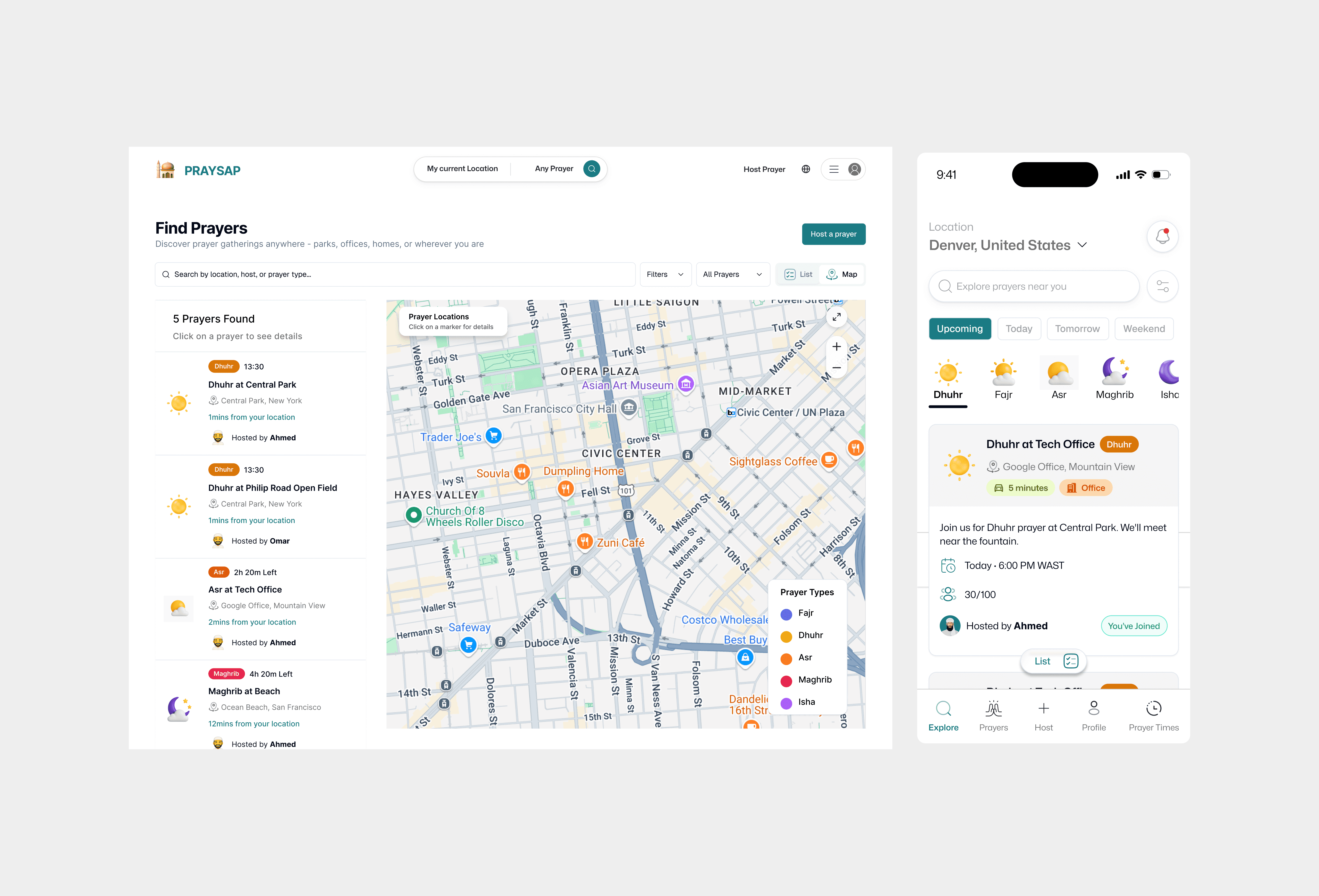
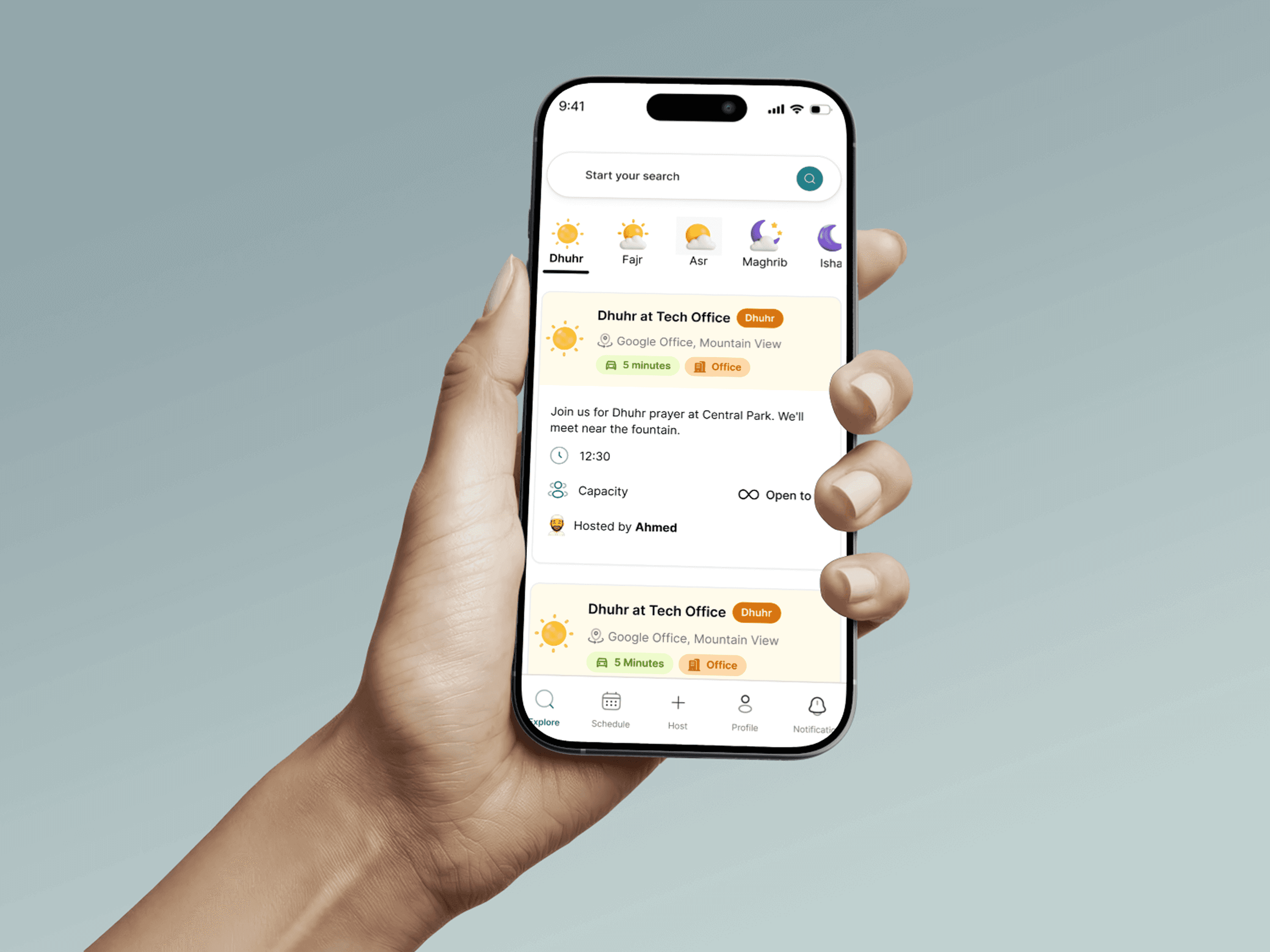
Praysap is a mobile app designed to make communal prayer accessible beyond physical mosques. It lets Muslims start and join prayer gatherings in homes, offices, outdoor spaces, or other temporary locations. With features like location-based discovery, privacy-controlled hosting, and community gamification, Praysap builds digital-first communities that still uphold religious practices.
Objectives
The objectives set the direction for building Praysap, focusing on accessibility, inclusivity, privacy and long-term growth.
Build Accessible Communities
Allow Muslims to coordinate prayers anywhere, even in mosque-scarce regions.
Encourage Social Interaction
Create digital-first tools to foster group prayer and shared religious practice.

Support Future Growth
Collect insights from usage patterns to inform mosque planning and expand into a broader Muslim super app.
Strategic Value
Praysap shows how design can address faith-based community challenges using technology. It not only solves prayer accessibility issues but also creates new opportunities for Muslims to connect, organize, and grow communities digitally, setting the stage for a larger ecosystem of Islamic lifestyle tools.
Prayer Creation Flow
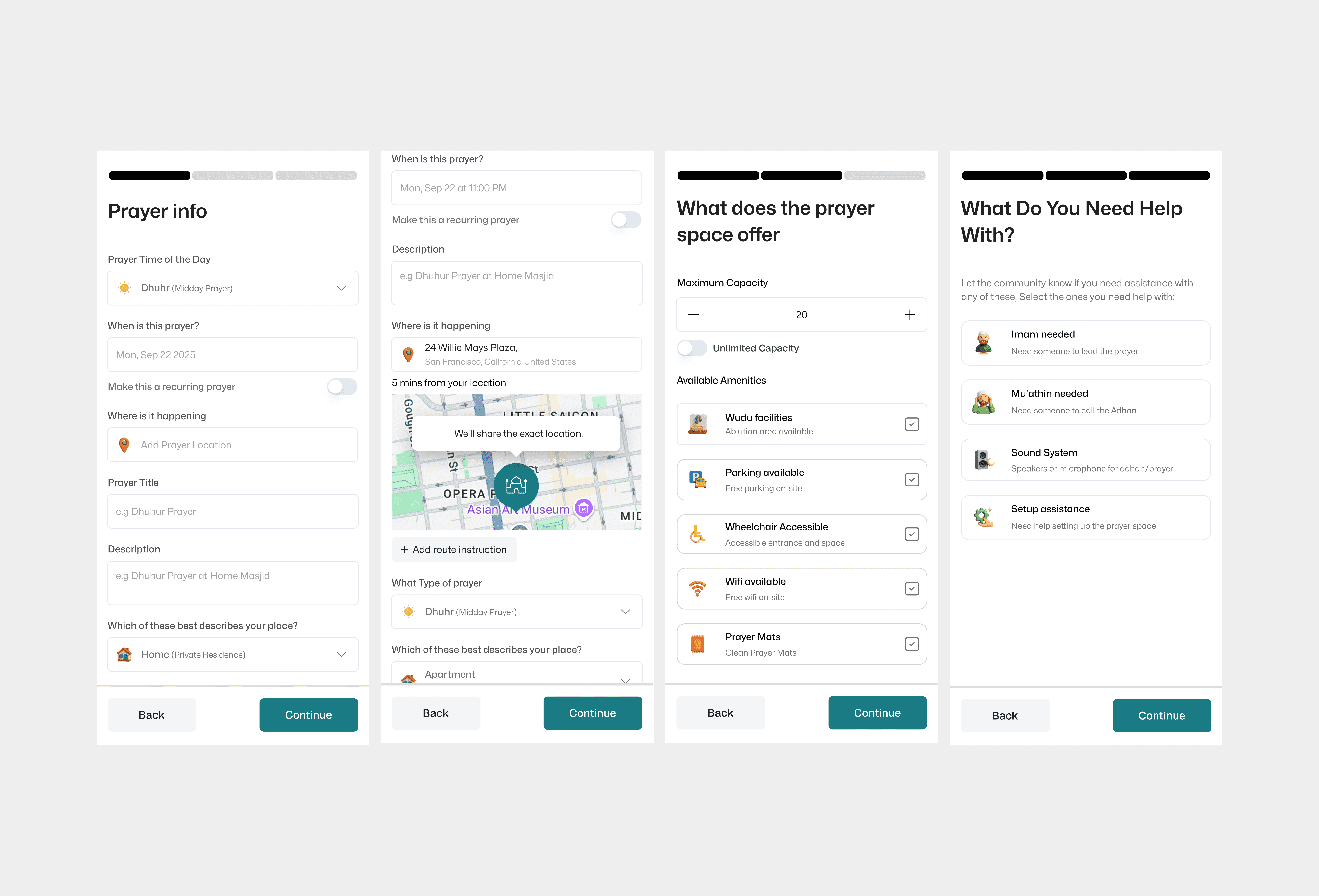
A guided four-step system that allows users to set up prayers by choosing type, location, amenities, and privacy controls. This makes it easy for anyone to host a gathering, whether in a home, office, or outdoor space.
Prayer Discovery System
A dual map and list-based interface that helps users quickly browse and join nearby prayers. Filters for time, type, and capacity ensure gatherings are easy to find and accessible to different needs.
Shahada Gated Profiles
Built-in verification ensures that only authenticated Muslims can create or join prayers, building trust and safeguarding the integrity of the community.
The Challenges
Every project faces real constraints. For Praysap, the main challenges were shaped by cultural expectations, geographic disparities, and the realities of building a usable product for diverse Muslim communities worldwide. These challenges guided design decisions and highlighted where technology could make the biggest impact.
Lack of Mosque Access in Many Regions
Muslims in diaspora or underserved areas often had few communal prayer options, creating isolation and reduced opportunities for group worship.
Generational & Gender Gaps
Younger Muslims and women faced higher barriers to mosque attendance, with cultural norms and scheduling conflicts further widening the gap.
Safety & Privacy Concerns
Publicly sharing exact prayer locations raised issues of trust and security, especially in areas with limited Muslim populations.
Complexity of Existing Apps
Many current Islamic apps were overloaded with features, which made them confusing and discouraged adoption by everyday users.
Resource Shortages
Ad-hoc prayer groups often lacked essentials such as prayer mats, wudu facilities, or organized roles, limiting the quality of the communal experience.
The Plans
To address these challenges, we outlined practical design-led solutions. Each plan was crafted as a clear, outcome-oriented action that directly responds to user needs and cultural context. The goal was to keep the flow simple, trustworthy, and community-focused, while ensuring the app could scale globally.

Design a simple flow that lets users create or join prayers quickly without confusion

Introduce gender and privacy settings to make communal prayers safe and inclusive

Enable location based discovery so users can find nearby gatherings instantly

Build trust through Shahada verification, host approvals, and community reporting tools
Provide resource-sharing features so hosts can signal needs and attendees can contribute
Research & Discovery
Research was essential to understand the needs of Muslims across different regions and validate our design choices. We combined qualitative and quantitative methods to ensure that the app addressed real-world barriers and cultural expectations.
User Interviews
We conducted interviews with 15 Muslims across diaspora communities to uncover practical and emotional barriers to joining group prayers. These conversations gave us firsthand insights into trust, safety, and convenience issues.

Competitors Analysis
We studied existing Islamic and prayer apps to identify usability gaps, feature overload, and areas where coordination was either missing or too complex. This helped us avoid repeating common pitfalls.

Global Participation Research
We examined data on mosque accessibility and prayer participation in underserved regions. This revealed how geographic and cultural factors shaped prayer habits, especially in areas with few mosques.

Prototype Testing
We tested early wireframes and prototypes of the prayer discovery and creation flows with real users. This allowed us to refine navigation, reduce setup time, and validate the four-step creation process.

Users
Looking for a simple way to keep up with prayers while balancing studies, work, or social life. Values convenience and digital-first solutions.
Find nearby prayers quickly through map or list view.
Join prayers hosted by friends or community members.
Set reminders for upcoming prayers.
Host small gatherings in dorms, offices, or homes.
Struggles to find places to pray when traveling or in non-Muslim countries.
Finds existing Islamic apps cluttered and outdated.
Lacks social accountability, making it easy to skip prayers.

Imams and Prayer Organizers
Religious leaders or community hosts who want to coordinate group prayers and manage participation efficiently.
Create and manage prayer gatherings with clear details.
Approve or decline attendees for private gatherings.
Share prayer details with community members.
Track attendance and manage resources like mats or wudu facilities.
Difficult to reach dispersed members of the community.
Managing logistics (capacity, gender sections, resources) is time-consuming.
Lack of trusted digital platforms to verify participants.
Regular Muslims Seeking Community
Everyday Muslims reverts, professionals, women, travelers, and expats who simply want to join prayers and feel connected.
Discover prayers nearby based on location and time.
Join gatherings without needing to know the host personally.
Use filters (e.g., women-only prayers) to find suitable groups.
Engage socially through prayer participation.
Limited mosque access in diaspora or remote areas.
Safety and privacy concerns when joining prayers hosted by strangers.
Frustration when ad-hoc prayer groups lack structure or resources.

Reverts and New Muslims
Converts or those exploring Islam who need guidance, trust, and opportunities to connect through prayer as part of their learning journey.
Use the app to discover and attend prayers for social learning.
Connect with hosts or imams for guidance and mentorship.
Learn prayer routines and etiquette through group participation.
Share their spiritual journey with supportive communities.
Pain Points
Isolation due to lack of connections in the Muslim community.
Anxiety about joining prayers without knowing the norms.
Few digital tools cater to their specific onboarding needs.
Insights & Recommendation
After multiple testing rounds on the Praysap mobile app, several key usability insights emerged that shaped the final UI design. Each insight came from observing real users (Muslims across different regions) interacting with early prototypes of the prayer creation, discovery, and verification flows.
Insights 1
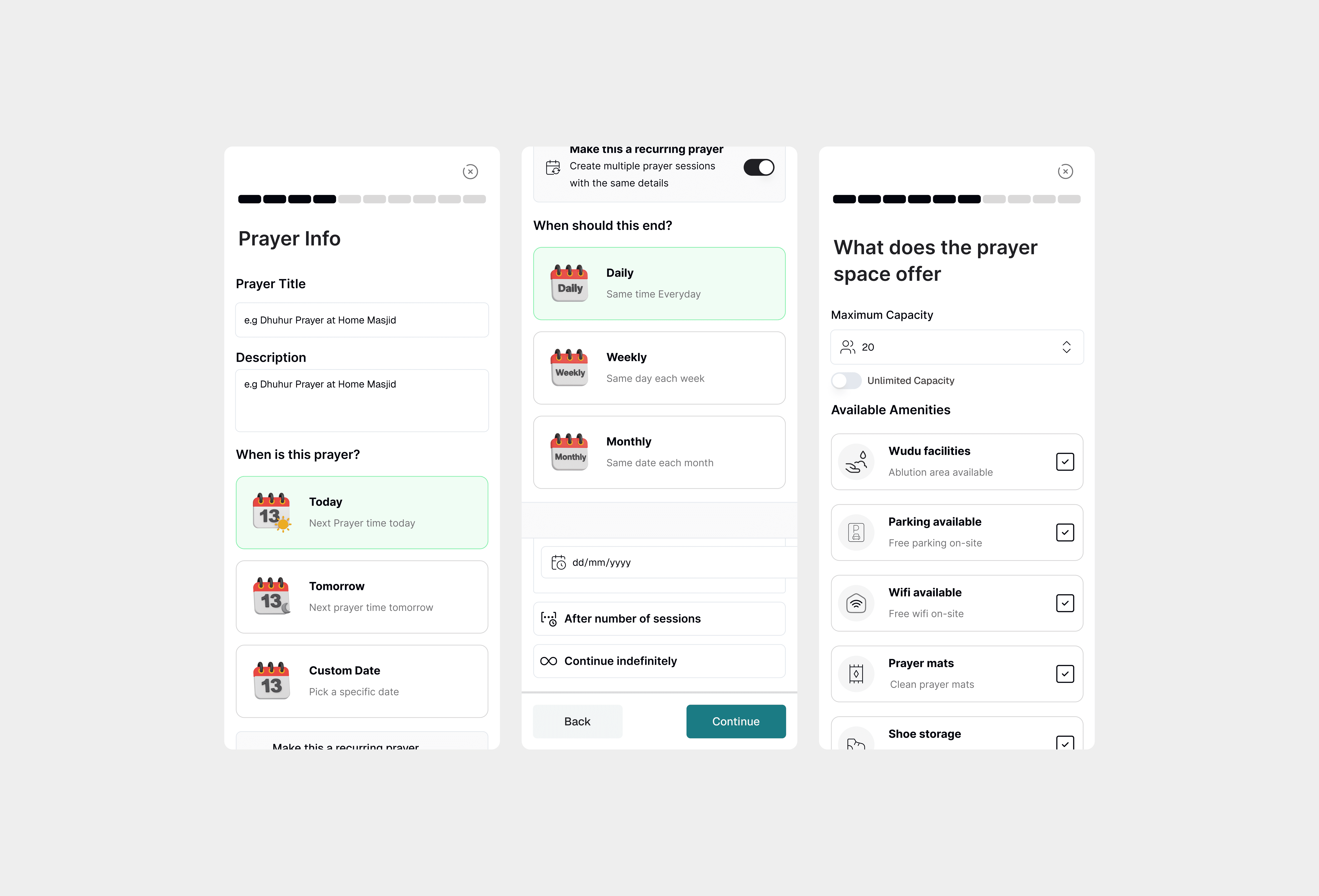
Users found the prayer creation process intimidating at first.
Many users, especially new hosts, hesitated when faced with multiple input fields and steps during prayer setup. They weren’t sure which options were required or what some fields meant (like space type or recurring settings). This caused early drop-offs during onboarding.
Recommendations 1
We simplified the flow into a clear three-step guided system with visible progress indicators. Each step now focuses on a single task choosing prayer type and other basic things, amenities you have ready for the prayers , things you need to make the prayer a success. This structure reduced confusion and helped users feel more in control.
Insights 2
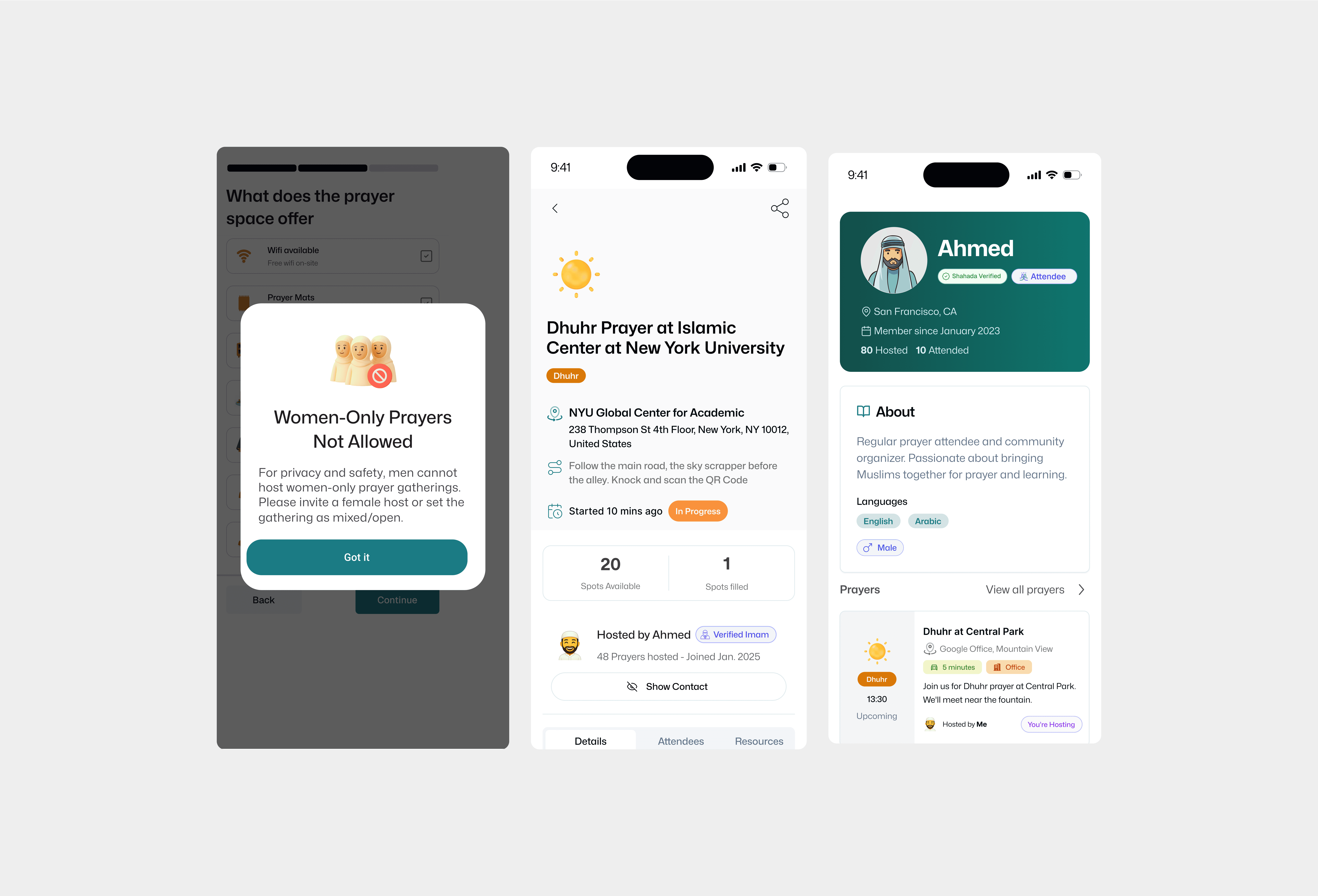
Women’s privacy and participation needed clearer safeguards.
During testing, several female users raised concerns about joining prayers hosted by men without knowing whether there was a designated women’s section. Others worried about men accidentally—or intentionally—creating “women-only” prayers. This created hesitation and trust issues among women who wanted to attend safely.
Recommendations 2
During testing, we noticed confusion around how gender-specific prayers were created and displayed. In some cases, male hosts accidentally created “women-only” prayers, which raised both religious and safety concerns. Female users also expressed discomfort joining prayers without clarity on who was leading or attending.
Insights 3
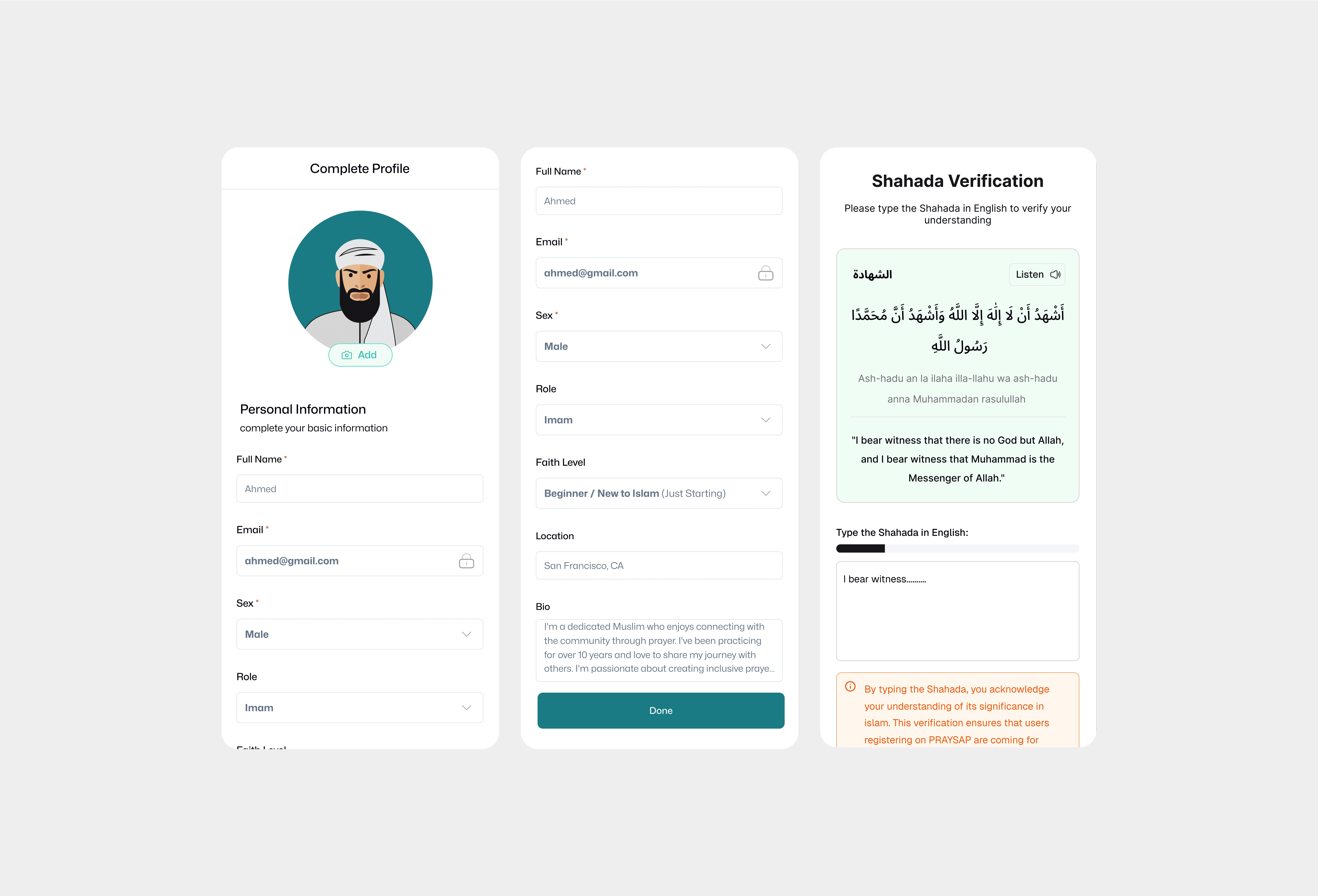
Users were concerned that non-Muslims could join or host prayers.
During testing, several users raised the issue that anyone could sign up and participate in prayers without confirming their faith. This created hesitation among hosts and attendees who wanted to ensure gatherings stayed authentic to Islamic practice and community integrity.
Recommendations 3
We introduced a Shahada gating system during onboarding. New users are now required to affirm the Shahada — the declaration of faith — before gaining access to prayer features. This not only prevents non-Muslims from joining prayers but also reinforces the app’s spiritual foundation and sense of trust among users.
Insights 4
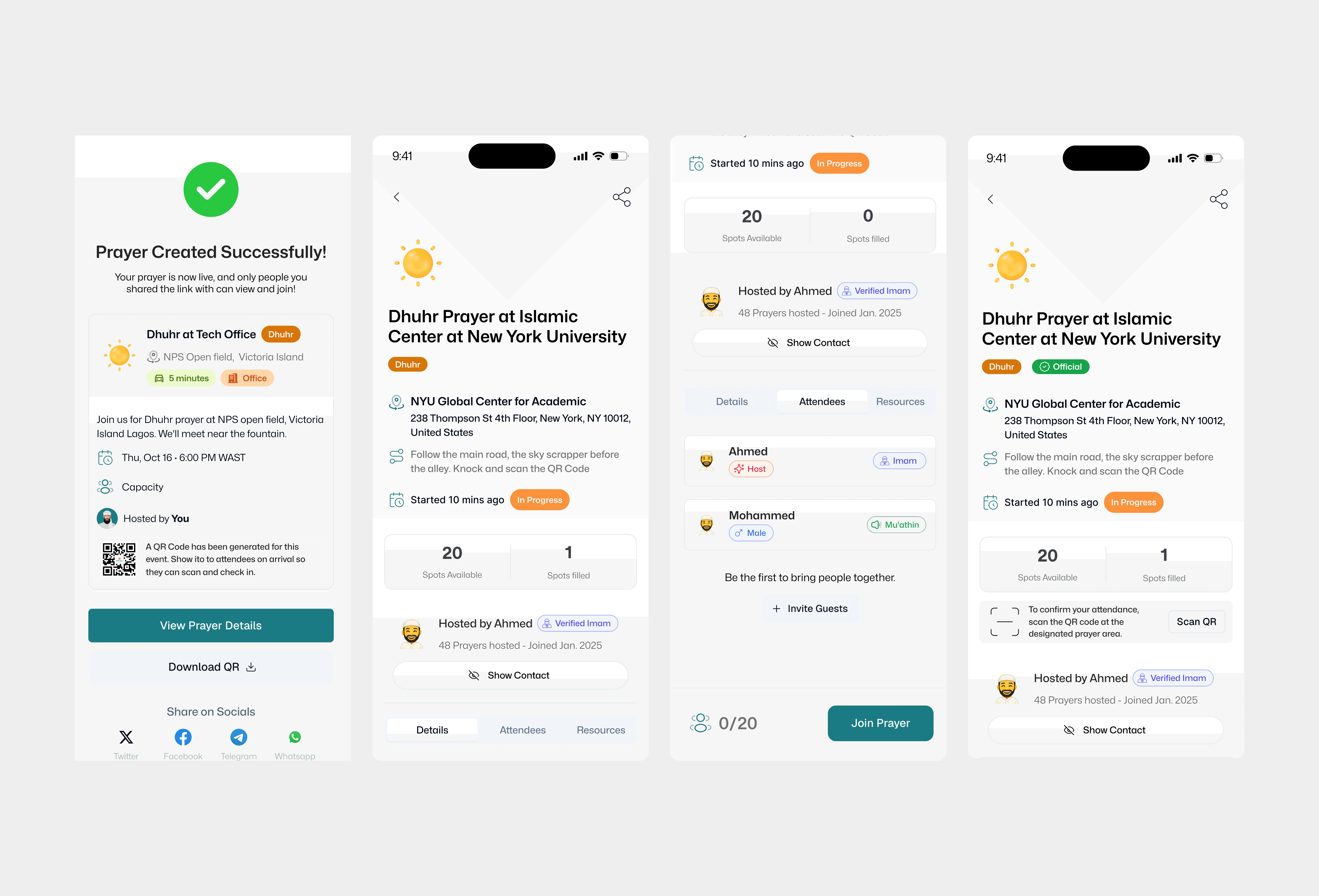
Users wanted more control and visibility over who attends prayers.
During testing, many users said they felt uneasy about not knowing who they would meet at a gathering. Hosts also wanted a way to approve attendees in advance especially for private or women-only prayers— while others preferred knowing who else had joined before committing.
Recommendations 4
We introduced a QR-based ticketing and attendee verification system to give hosts more control and improve event safety. When a prayer is created, a unique QR code is automatically generated for the host. This can be downloaded and used for on-site check-ins, allowing users to scan at entry. Alternatively, hosts can manage attendance manually by approving or rejecting requests during registration. This gives them two clear ways to control participation either through QR verification at the event or pre-approval before it begins.
Insights 3
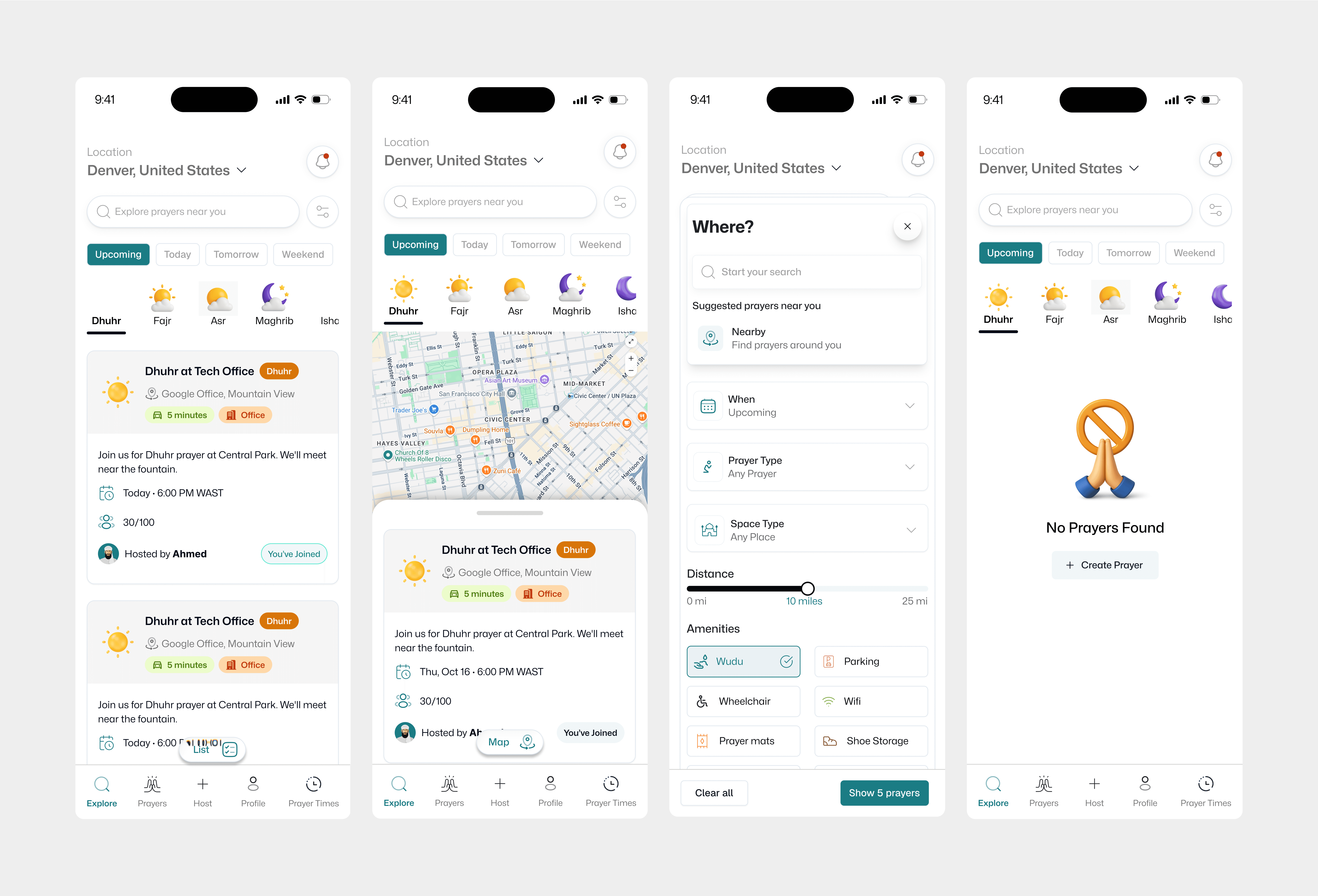
The map and list view were cluttered and visually overwhelming.
During testing, users said the map markers and prayer cards blended together. It was difficult to quickly distinguish between prayer types or find relevant gatherings near them.
Recommendations 5
We introduced color-coded markers for each prayer type (e.g., Fajr, Dhuhr, Asr) and cleaned up card layouts with consistent icons, spacing, and typography. We also added filters and sorting by distance, capacity, and gender settings to help users find what matters most.
Learnings
Building Praysap was more than just a design challenge—it was a cultural and spiritual exploration. The process helped our team understand the deeper nuances of faith-based design, community trust, and accessibility across diverse Muslim populations.
We learned that even simple design decisions, like language tone or icon choice, could carry deep religious significance. Every element from prayer verification to privacy settings had to respect Islamic values while remaining modern and intuitive. This experience reinforced the need for empathy, research, and consultation when designing for faith-centered products.
One of the most valuable lessons was finding harmony between innovation and religious authenticity. While users appreciated digital convenience, they were quick to notice when something felt too “techy” or disconnected from real worship. This taught us the importance of grounding every feature in purpose, not just functionality.
Introducing Shahada gating and host verification reminded us that trust is the foundation of any community app. Users wanted to know that the people they prayed with were genuine. Communicating how and why verification existed became as important as the feature itself.
Testing across different regions revealed wide variations in how Muslims engage with prayer—from reverts discovering Islam to lifelong practitioners. This diversity pushed us to design flexible flows and inclusive features, ensuring the app felt personal and respectful regardless of background or level of practice.
Next Steps
We’ll add an accurate Qibla compass and prayer time tracker powered by geolocation. This feature will make it easier for users especially travelers and new converts to orient toward Mecca and perform prayers correctly wherever they are.
We plan to integrate verified donation channels directly into Praysap. Users will be able to contribute to local mosques, aid programs, or global Islamic charities safely through the app. This will extend the platform’s mission—connecting not just through prayer, but through shared compassion and giving.
Copyright 2024 by Adewale Michael